Welcome to our On Location series, where we journey deep into the unforgettable worlds, hidden realms, and legendary settings of the HamWeg Galaxy.
This series explores the places where adventure happens and legends are born.
Join us as we uncover the rich history, secrets, and wonder behind the amazing locations that make the HamWeg Galaxy so vast and unforgettable.
Ape Planet: A World Forged Under Two Suns
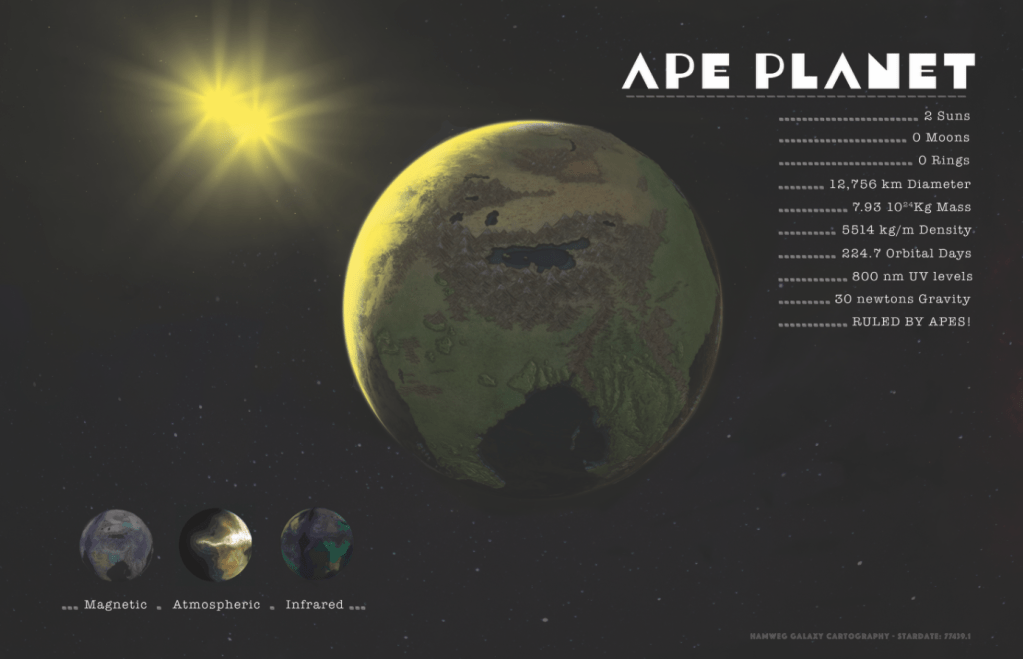
In the far reaches of the HamWeg Galaxy, few worlds feel as immediately striking and mysterious as Ape Planet.
At first glance, it is a planet of harsh beauty, a rugged sphere of jungled terrain, deep basins, and ancient oceans all suspended beneath the blazing light of two suns. But the more one studies Ape Planet, the clearer it becomes that this is no ordinary world. It is a place of beauty shaped by extreme conditions, fierce survival, and the unchallenged rule of apes.
What makes Ape Planet so fascinating begins with its sky. Unlike Earth, this world orbits beneath two suns, bathing its surface in intense and strong UV light. The twin-star system gives the planet a distinct character, casting long, dramatic shadows across its continents and contributing to its environmental conditions.
With 800 nm UV levels, Ape Planet is a world where radiation and sunlight are defining forces, influencing everything from the climate to the evolution of life itself.
Physically, Ape Planet is almost eerily Earth-sized, measuring 12,756 kilometers in diameter. Its mass of 7.93 × 10²⁴ kilograms and density of 5514 kg/m mark it as a heavy, substantial terrestrial world, dense, powerful, and built like a planet meant to endure.
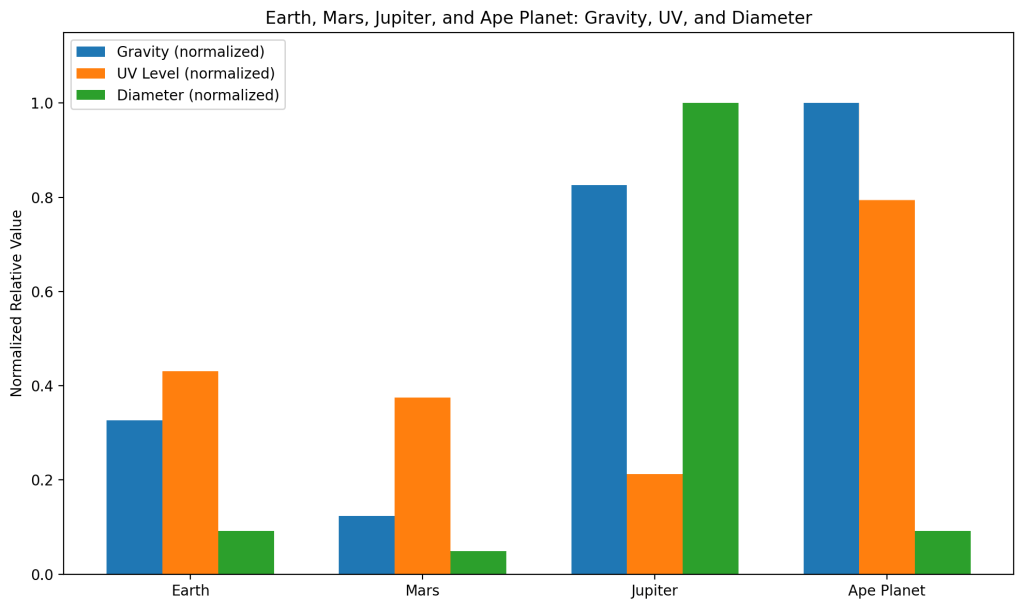
Despite that familiar size, Ape Planet is no mirror of Earth. Its conditions are more severe, its UV levels more dangerous, and its gravity far less forgiving.
With 30 newtons of gravity, Ape Planet exerts a powerful pull on all who walk its surface. Even with protection for humans, movement would be harder with flight being very difficult. It is the kind of planet that would naturally favor powerful bodies with dense musculature forged for endurance.
Survival demands strength and adaptation.
Orbitally, Ape Planet completes its path around its suns in 224.7 days, giving it a shorter year than Earth. This creates compressed seasonal cycles and a rhythm of life very different from the inhabitants of Earth experience. Time itself moves differently there. Harvests, migrations, rituals, and wars may all be shaped by that quicker celestial pace.
Just as notable is what Ape Planet does not have. It has no moons and no rings. The skies above are not decorated by drifting satellites or great celestial bands. Instead, the heavens are dominated by the stark power of its twin suns and the vast emptiness beyond.
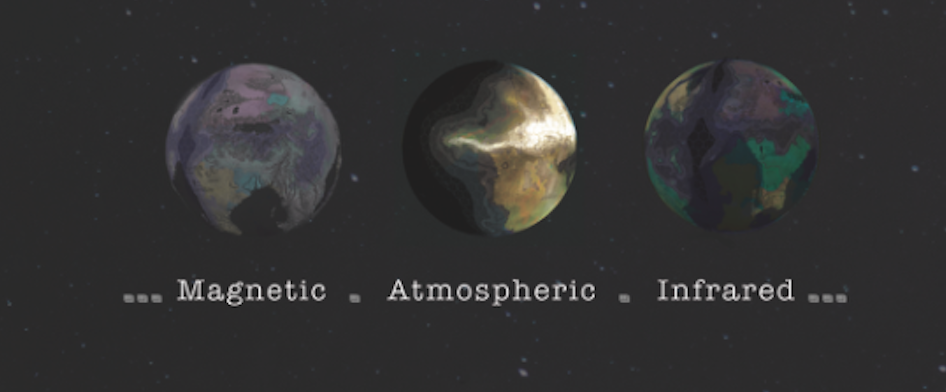
Magnetic, atmospheric, and infrared views suggest a world of dramatic environmental variation, hinting at unusual geological structures, heat patterns and atmospheric behavior.
In the HamWeg Galaxy, Ape Planet stands apart because it feels primal and cosmic at the same time. It is a world of science-fiction scale and mythic imagination, a planet where astronomy, environment, and power all converge into one unforgettable setting.
With its twin suns, punishing gravity, harsh ultraviolet exposure, and ape rulers, Ape Planet demands respect.
The HamWeg Galaxy and all names and characters are fictitious.
No identification with actual persons (living or deceased) is intended or should be inferred.

 HamWeg Galaxy Library
Leave a comment